

Managing rental properties requires more than collecting rent and scheduling repairs. Behind every successful property investment lies a sophisticated financial infrastructure that protects assets, ensures compliance, and delivers transparent reporting. Property management accounts form the backbone of this infrastructure, serving as the critical system that tracks every dollar flowing through your rental portfolio. For property owners in the Greater New Orleans area, understanding how these accounts function can mean the difference between maximizing returns and facing costly financial complications.
Understanding Property Management Accounts
Property management accounts represent specialized financial systems designed specifically for tracking rental property income and expenses. These accounts differ fundamentally from standard business accounting because they manage funds belonging to multiple property owners while maintaining strict legal separation between client assets and management company operations.
The complexity increases with portfolio size. A single-property owner might track basic income and expenses, but professional property managers handling dozens or hundreds of units require sophisticated accounting structures. These systems must accommodate security deposits held in trust, operating expenses paid on behalf of owners, rental income collected from tenants, and owner distributions processed monthly.
Core Components of Property Management Accounting
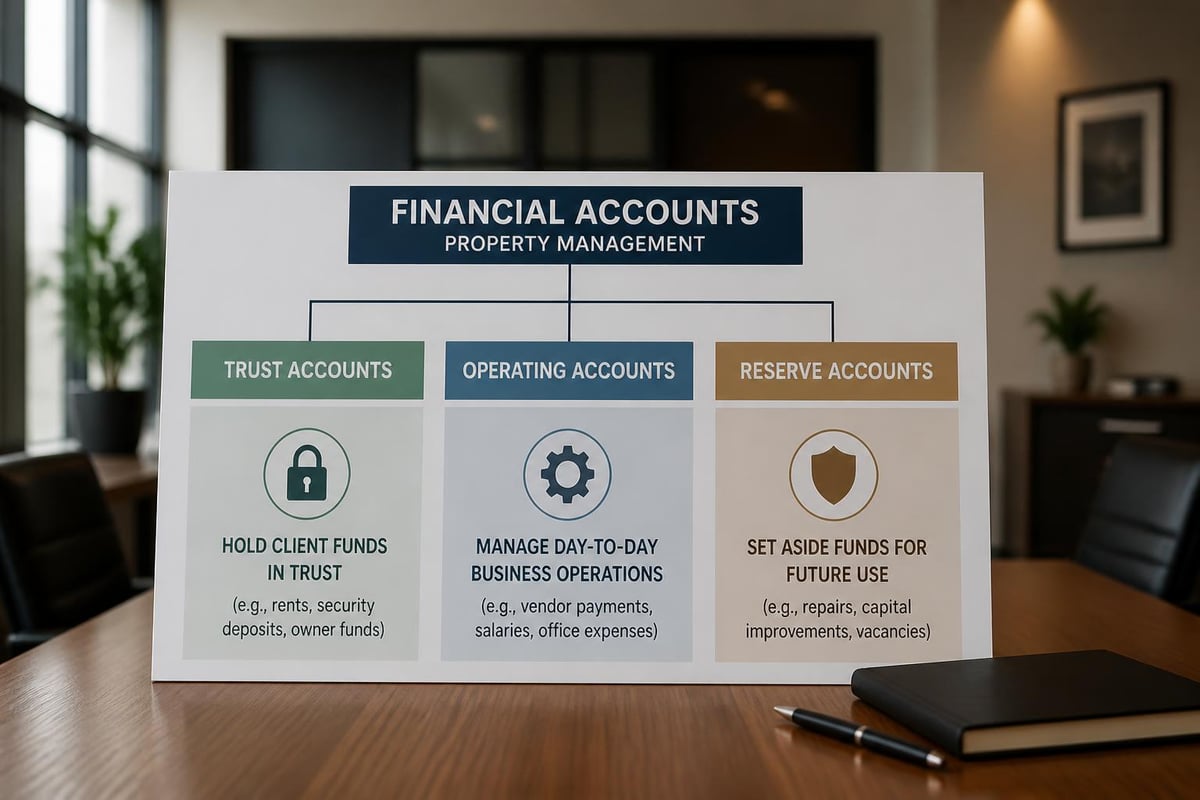
The foundation of property management accounts rests on several essential elements that work together to create a comprehensive financial picture:
- Trust accounts that hold tenant security deposits and advance rent payments
- Operating accounts for managing day-to-day property expenses and income
- Owner reserve accounts for setting aside funds for capital improvements
- Detailed ledgers tracking income and expenses by property and unit
- Reconciliation systems ensuring accurate monthly reporting
Each component serves a distinct purpose in protecting both property owners and management companies from financial liability. Property management accounting carries significant fiduciary responsibilities that require meticulous attention to detail and regulatory compliance.
Setting Up Proper Account Structures
Establishing correct account structures from the outset prevents countless headaches down the road. Property management accounts must maintain clear boundaries between different fund types to satisfy legal requirements and provide transparent reporting to property owners.
The first step involves creating separate bank accounts for different purposes. Commingling funds represents one of the most serious violations in property management. Security deposits must remain in dedicated trust accounts, completely separate from operating funds and management company revenue. This separation protects tenant deposits and ensures compliance with Louisiana state regulations.
Chart of Accounts Organization
A well-organized chart of accounts provides the framework for all financial tracking. This system categorizes every transaction into specific accounts that roll up into comprehensive financial statements:
| Account Category | Purpose | Examples |
|---|---|---|
| Income Accounts | Track all revenue sources | Rental income, late fees, pet fees, parking fees |
| Operating Expenses | Regular property costs | Utilities, landscaping, pest control, insurance |
| Capital Expenses | Major improvements | Roof replacement, HVAC systems, renovations |
| Administrative Costs | Management fees | Property management fees, legal costs, accounting |
Property managers serving the New Orleans market must also account for region-specific expenses such as flood insurance, hurricane preparation costs, and specialized maintenance requirements for historic properties. These unique considerations demand customized account structures that reflect local market realities.
Best Practices for Financial Management
Implementing proven best practices transforms property management accounts from basic record-keeping into powerful tools for maximizing property performance. These practices protect all stakeholders while creating operational efficiency that scales with portfolio growth.
Monthly Reconciliation Procedures
Regular account reconciliation forms the cornerstone of accurate financial management. Every account should be reconciled monthly, comparing bank statements against internal ledgers to identify discrepancies immediately. This process catches errors before they compound, identifies potential fraud, and ensures owner reports reflect actual financial positions.
Reconciliation extends beyond bank accounts. Property managers must also reconcile:
- Tenant ledgers against rent rolls to verify all payments are properly credited
- Security deposit accounts ensuring held amounts match tenant records
- Accounts payable confirming all vendor invoices are accurately recorded
- Owner distributions verifying payments match approved amounts
- Inter-account transfers tracking fund movements between accounts
Best practices in property management accounting emphasize the importance of standardization across all properties. Creating consistent procedures ensures accuracy regardless of who performs the work and simplifies training for new team members.
Expense Tracking and Categorization
Detailed expense tracking provides invaluable insights for property owners making investment decisions. Every expense should be categorized correctly, assigned to the appropriate property, and documented with supporting receipts or invoices. This level of detail enables sophisticated analysis of property performance.
Modern property management accounts benefit from automation that reduces manual data entry while improving accuracy. Digital receipt capture, automated bill pay, and integrated vendor management streamline processes that once consumed hours of administrative time. For companies managing significant portfolios like those worth hundreds of millions in assets, these efficiencies multiply across every property.

Revenue Management and Rent Collection
Revenue management in property management accounts requires systems that accurately track multiple income streams while providing clear audit trails. Rent collection represents the primary income source, but properties often generate additional revenue from parking fees, late charges, pet rent, and utility reimbursements.
Rent Roll Management
The rent roll serves as the master document connecting tenants, units, and financial obligations. An accurate rent roll forms the foundation for reliable property management accounts, containing critical information including:
- Current tenant names and contact information
- Lease start and end dates
- Monthly rent amounts and payment schedules
- Security deposit amounts held
- Outstanding balances and payment histories
- Recurring charges beyond base rent
Integration between rent rolls and accounting systems eliminates duplicate data entry and reduces errors. When a tenant pays rent, the system should automatically update both the tenant ledger and the property's income accounts, creating a seamless flow of financial information.
Handling Late Payments and Collections
Late payment tracking within property management accounts serves dual purposes: it protects owner cash flow and maintains clear records for potential legal proceedings. Policies must be consistently applied and thoroughly documented. When tenants fall behind on rent, the accounting system should flag these accounts, calculate late fees according to lease terms, and generate collection notices automatically.
Successful property management services in the Greater New Orleans area balance firmness with compassion, recognizing that economic challenges sometimes affect good tenants. Documentation in property management accounts provides the objective record necessary for making informed decisions about payment plans versus eviction proceedings.
Trust Account Management
Trust accounts represent perhaps the most legally sensitive aspect of property management accounts. These accounts hold funds belonging to others, requiring strict compliance with state regulations and fiduciary standards. Mismanagement of trust accounts can result in license suspension, legal liability, and criminal charges.
Louisiana law mandates specific requirements for security deposit handling. Property managers must maintain these funds in separate interest-bearing accounts, provide detailed accounting upon lease termination, and return deposits within specified timeframes. Streamlining accounts payable processes becomes particularly critical when managing trust funds across multiple properties.
Security Deposit Reconciliation
Monthly reconciliation of security deposit accounts ensures held amounts match tenant records exactly. This process involves:
- Listing all active tenants and their deposit amounts
- Verifying the total matches the trust account balance
- Investigating any discrepancies immediately
- Documenting the reconciliation with supporting evidence
- Maintaining audit trails for regulatory compliance
Property managers handling nearly $1 billion in assets understand that trust account integrity represents the foundation of client confidence. One mishandled security deposit can damage relationships built over decades of reliable service.
Owner Reporting and Transparency
Transparent owner reporting distinguishes exceptional property management from mediocre service. Property management accounts should generate clear, comprehensive reports that help owners understand property performance and make informed decisions about their investments.
Monthly Owner Statements
Effective owner statements present financial information in accessible formats that require no accounting degree to understand. These statements typically include:
| Report Section | Information Provided |
|---|---|
| Income Summary | Total rent collected, other income, vacancy losses |
| Expense Detail | All costs by category with supporting documentation |
| Net Operating Income | Revenue minus expenses before debt service |
| Owner Distribution | Amount transferred to owner's account |
| Reserve Balance | Funds held for future capital improvements |
| Variance Analysis | Comparison to budget or previous periods |
Digital reporting platforms enable real-time access to financial information, allowing owners to check property performance whenever they choose rather than waiting for monthly statements. This transparency builds trust and demonstrates the professionalism that sets leading management companies apart from competitors.
Technology and Automation
Modern property management accounts increasingly leverage technology to improve accuracy, efficiency, and scalability. Property management software solutions available in 2026 offer sophisticated features that automate routine tasks while providing powerful analytical capabilities.
Integration represents a key advantage of modern systems. When property management accounts connect seamlessly with online rent collection, maintenance management, and tenant portals, information flows automatically between systems. This integration eliminates duplicate data entry, reduces errors, and creates real-time visibility into property performance.
Selecting Accounting Software
Choosing appropriate accounting software requires evaluating several critical factors:
- Multi-property support enabling efficient management of growing portfolios
- Trust accounting capabilities maintaining legal compliance for security deposits
- Owner portal access providing transparency without administrative burden
- Automated reconciliation reducing manual accounting work
- Customizable reporting delivering insights specific to owner needs
- Mobile accessibility enabling management from anywhere
- Vendor integration connecting with other property management tools
The investment in robust software pays dividends through reduced administrative costs, improved accuracy, and enhanced owner satisfaction. For property managers serving areas like Gert Town in New Orleans, software that handles local tax nuances and regulatory requirements becomes particularly valuable.

Compliance and Regulatory Considerations
Property management accounts must adhere to numerous regulatory requirements at federal, state, and local levels. Compliance protects both property managers and owners from legal liability while ensuring ethical treatment of tenant funds.
Tax Reporting Obligations
Accurate property management accounts simplify tax preparation for property owners. The system should track and categorize all income and expenses according to IRS guidelines, generating reports that accountants can use directly for tax return preparation. Key considerations include:
- Properly classifying capital improvements versus repairs
- Tracking depreciation schedules for equipment and improvements
- Documenting business expenses for deduction purposes
- Separating personal versus rental property expenses for mixed-use properties
- Generating 1099 forms for contractors paid over threshold amounts
Professional property management accounting practices ensure compliance while maximizing legitimate tax advantages available to property owners. This expertise adds substantial value beyond basic rent collection services.
Common Challenges and Solutions
Even well-designed property management accounts face recurring challenges that require proactive solutions. Understanding these common issues helps property managers implement preventive measures rather than reactive fixes.
Cash Flow Management
Maintaining positive cash flow across multiple properties requires careful planning and monitoring. Expenses don't always align neatly with rent collection cycles, creating temporary shortfalls that must be managed. Effective strategies include:
- Maintaining adequate operating reserves for each property
- Scheduling major expenses after rent collection when possible
- Communicating proactively with owners about upcoming capital needs
- Implementing late fee policies that encourage timely payment
- Using automated payment systems to accelerate rent collection
For owners considering rental property investment in New Orleans, understanding cash flow management becomes essential for long-term success. Professional property managers bring expertise in navigating these challenges across diverse property types and market conditions.
Audit Preparation
Property management accounts should always be audit-ready, maintaining documentation and organization that would satisfy external review. This preparation serves multiple purposes:
- Owner confidence through transparent, verifiable records
- Legal protection if disputes arise with tenants or vendors
- Regulatory compliance when authorities request documentation
- Business continuity enabling smooth transitions if management changes
Implementing effective bookkeeping practices creates systems that naturally support audit readiness without requiring special preparation when reviews occur. This ongoing discipline represents a hallmark of professional property management operations.
Performance Analysis and Optimization
Beyond basic record-keeping, sophisticated property management accounts enable deep performance analysis that drives better investment decisions. Financial data becomes strategic intelligence when properly analyzed and presented.
Key Performance Indicators
Tracking specific metrics helps property owners evaluate performance and identify improvement opportunities:
| KPI | Calculation | Purpose |
|---|---|---|
| Occupancy Rate | (Occupied Units / Total Units) × 100 | Measures demand and market positioning |
| Net Operating Income | Gross Income – Operating Expenses | Shows property profitability before financing |
| Operating Expense Ratio | Operating Expenses / Gross Income | Indicates efficiency of property operations |
| Return on Investment | Net Income / Total Investment | Measures overall investment performance |
| Average Days Vacant | Total Vacancy Days / Number of Turnovers | Assesses leasing efficiency |
Regular analysis of these metrics reveals trends that might otherwise go unnoticed. A gradually increasing operating expense ratio might indicate deferred maintenance problems or inefficient vendor relationships requiring attention. Property management accounts that calculate and track these KPIs automatically provide invaluable management intelligence.
Budgeting and Forecasting
Forward-looking financial management uses historical data from property management accounts to create realistic budgets and forecasts. Annual budgeting processes should involve:
- Analyzing previous year actual expenses by category
- Identifying known changes affecting the coming year
- Researching market trends for insurance, taxes, and utilities
- Planning for necessary capital improvements
- Setting realistic occupancy and rental rate assumptions
- Building appropriate contingency reserves
Variance analysis comparing actual results to budget highlights areas requiring management attention and helps refine future forecasting accuracy. Property management accounting fundamentals emphasize this cyclical process of planning, executing, analyzing, and adjusting as essential for sustained success.
Proper property management accounts protect your investment through accurate tracking, regulatory compliance, and transparent reporting that empowers informed decision-making. Whether you own a single rental unit or a diverse portfolio, these financial systems form the foundation for maximizing returns while minimizing risk. With over 40 years of experience managing nearly $1 billion in assets across the Greater New Orleans area, Coxe Property Management and Leasing delivers the expertise, technology, and personal attention needed to handle every aspect of your property's financial management. Let our proven systems and dedicated team protect your investment while you enjoy the benefits of hassle-free property ownership.