

Property managers in the Greater New Orleans area face mounting demands from property owners, tenants, maintenance teams, and regulatory agencies. Effective time property management has become the foundation of successful property operations, particularly as portfolios expand and tenant expectations rise. With residential vacancies shifting and rental markets evolving, property managers must implement sophisticated systems that optimize every hour of their workday while maintaining quality service standards across multiple properties.
Understanding the Core Principles of Time Property Management
Time property management represents a systematic approach to organizing, prioritizing, and executing the countless tasks required to maintain rental properties effectively. Rather than simply reacting to emergencies and tenant requests as they arise, successful property managers develop structured workflows that prevent small issues from escalating into major problems.
The foundation begins with understanding which tasks generate the highest return on investment for property owners. Revenue-generating activities such as tenant screening and lease renewals deserve priority over routine administrative work that can be automated or delegated. This strategic thinking separates property managers who struggle to keep up from those who consistently deliver exceptional results.
Categorizing Daily Responsibilities
Property management encompasses diverse responsibilities that fall into distinct categories requiring different time allocation strategies:
- Tenant communication and relationship management
- Property maintenance coordination and vendor oversight
- Financial reporting and rent collection processes
- Legal compliance and documentation
- Marketing and vacancy filling
- Property inspections and preventive maintenance
Each category demands specific attention patterns. Tenant emergencies require immediate response capabilities, while financial reporting follows monthly cycles. Recognizing these natural rhythms allows managers to structure their schedules around predictable demands rather than constantly fighting fires.
Implementing Priority Matrix Systems
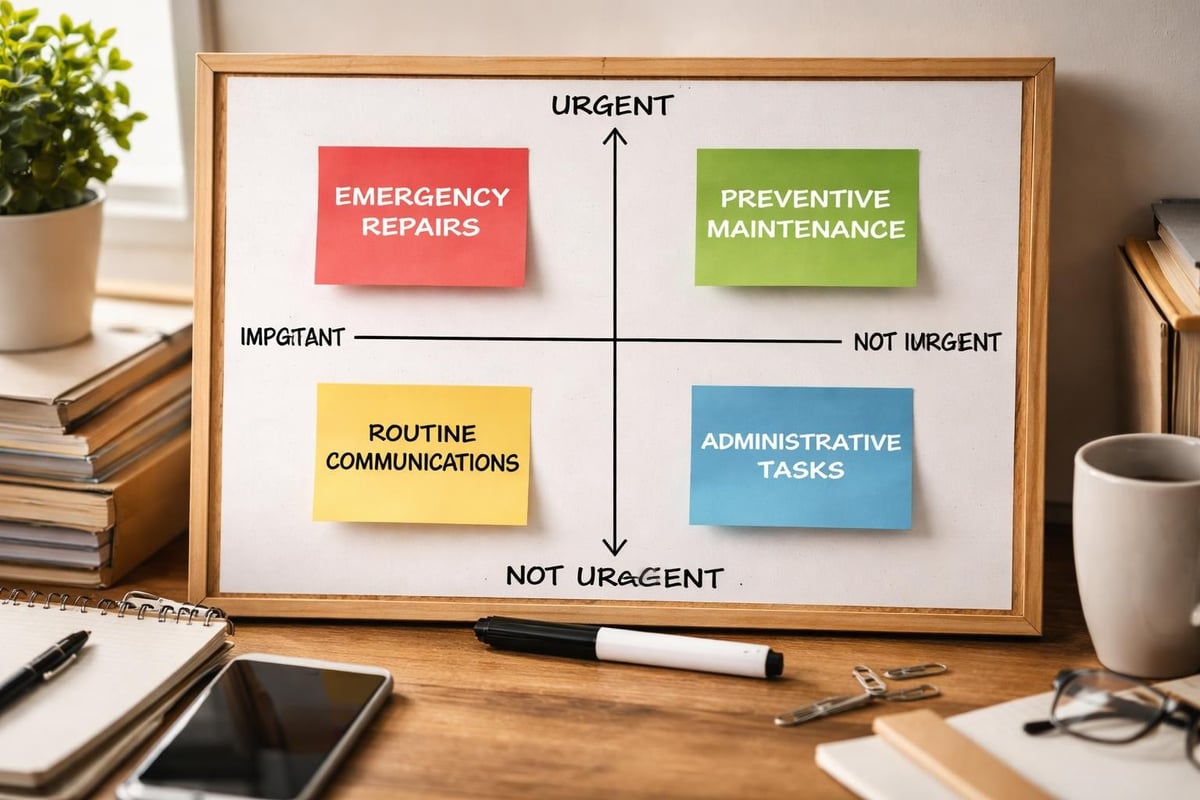
Professional property managers benefit from adopting structured priority frameworks that distinguish between urgent and important tasks. The Eisenhower Matrix provides an excellent foundation for time property management decisions, dividing responsibilities into four quadrants based on urgency and importance.
Critical and Urgent: These include tenant emergencies like water leaks, heating failures during winter months, or security concerns. New Orleans property managers know that issues with air conditioning during summer months fall into this category, requiring immediate attention to prevent tenant health and safety problems.
Important but Not Urgent: Strategic activities such as preventive maintenance scheduling, lease renewal planning, and relationship building with quality vendors occupy this quadrant. These tasks prevent future emergencies but often get postponed when managers fail to protect time for proactive work.
| Priority Level | Task Examples | Time Allocation |
|---|---|---|
| Critical-Urgent | Emergency repairs, eviction deadlines | Immediate response |
| Important-Not Urgent | Preventive maintenance, tenant retention | 40% of weekly time |
| Urgent-Not Important | Some phone calls, minor tenant requests | Delegate or batch process |
| Neither Urgent nor Important | Excessive email checking, unnecessary meetings | Eliminate or minimize |
The distinction between urgent and important transforms how property managers allocate their most valuable resource: focused attention. By scheduling dedicated blocks for important non-urgent work, managers prevent small maintenance issues from becoming expensive emergency repairs.
Leveraging Technology for Operational Efficiency
Modern time property management relies heavily on integrated software systems that automate repetitive tasks and centralize information. Property management platforms streamline processes that previously consumed hours of manual effort each week.
Automated rent collection eliminates the need to chase payments manually, sending reminders to tenants and processing electronic payments without manager intervention. This single automation saves property managers approximately five to eight hours monthly across a portfolio of twenty units.
Essential Technology Integration Points
Digital tools transform multiple aspects of property operations:
- Online maintenance request portals that route work orders directly to appropriate vendors
- Automated tenant screening services that verify income, credit, and rental history
- Digital lease signing platforms reducing paperwork and storage requirements
- Cloud-based accounting systems generating owner reports automatically
- Communication platforms that maintain organized records of all tenant interactions
Many property managers discover that implementing routine time management strategies reduces daily stress while improving response times. Technology enables managers to serve more properties without proportionally increasing work hours, creating scalability previously impossible with manual systems.
The renter portal concept exemplifies this efficiency. By providing tenants with self-service access to account information, managers eliminate dozens of routine inquiries about payment status, lease terms, and maintenance request updates. This frees time for higher-value activities that directly impact property performance.
Structuring Your Weekly Schedule
Effective time property management requires intentional schedule design rather than reactive day-to-day responses. Successful property managers build structured weeks around predictable patterns while maintaining flexibility for genuine emergencies.
Time-blocking creates dedicated periods for specific task categories. Designating Monday mornings for financial reviews and payment processing establishes routine that prevents these critical tasks from being perpetually postponed. Similarly, setting aside Thursday afternoons for property inspections ensures consistent oversight across the portfolio.
Sample Weekly Time Allocation Framework
Monday Focus: Financial processing, rent collection follow-up, owner communication
Tuesday Focus: Maintenance coordination, vendor meetings, work order management
Wednesday Focus: Marketing and leasing activities, property showings, application processing
Thursday Focus: Property inspections, preventive maintenance verification, lease compliance
Friday Focus: Administrative completion, next-week planning, team coordination
This structure doesn't mean rigidly refusing to address Tuesday emergencies on Monday. Rather, it creates default patterns that prevent important activities from constantly yielding to less critical interruptions. Property managers who maintain running task lists report significantly higher completion rates for strategic initiatives.
Mastering Delegation and Outsourcing
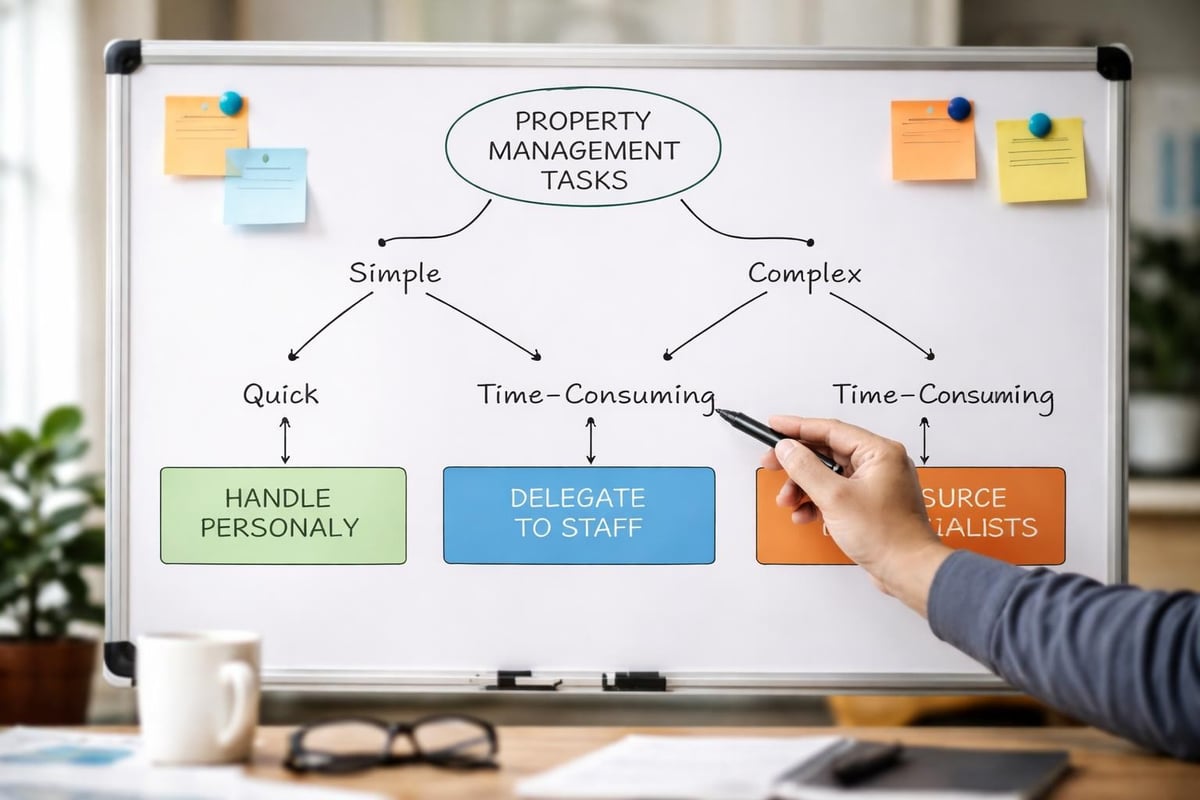
Time property management reaches peak effectiveness when managers recognize they cannot personally handle every task efficiently. Strategic delegation to team members, specialized vendors, and service providers multiplies productive capacity.
Property maintenance coordination illustrates this principle perfectly. Rather than personally visiting properties to assess every repair need, effective managers develop relationships with trusted contractors who provide accurate diagnoses and fair estimates. The manager's role shifts from hands-on assessment to quality oversight and vendor performance management.
Administrative tasks present excellent delegation opportunities. Data entry, basic tenant inquiries, and routine correspondence can be handled by support staff, freeing managers for judgment-intensive responsibilities that directly impact property value and owner satisfaction.
Tasks Worth Outsourcing
- Specialized repairs requiring licensed contractors
- Legal proceedings including eviction services
- Landscaping and seasonal maintenance
- Deep cleaning between tenant turnovers
- Professional photography for marketing vacant units
- Accounting and bookkeeping functions
The investment in outsourcing often generates positive returns by preventing costly mistakes and allowing managers to focus on revenue-generating activities. A property manager spending three hours attempting a repair might save $200 in contractor fees but loses the opportunity to secure a new lease worth thousands in annual revenue.
Building Effective Communication Systems
Communication consumes substantial portions of every property manager's day. Without structured systems, responding to tenant inquiries, owner updates, and vendor coordination can easily occupy entire workdays while leaving critical tasks incomplete.
Batching communication creates efficiency through focused attention. Rather than responding to each email immediately upon arrival, designating specific times for email processing prevents constant context-switching that destroys productivity. Most tenant questions don't require instant responses, and setting expectations for 24-hour reply windows allows managers to work without perpetual interruptions.
Template libraries accelerate routine communications. Standardized responses for common scenarios-lease renewal offers, maintenance request acknowledgments, late payment reminders-maintain consistency while reducing composition time by 60-70 percent. Personalizing templates takes seconds compared to drafting messages from scratch repeatedly.
| Communication Type | Response Timeframe | Recommended Approach |
|---|---|---|
| Emergency maintenance | Within 2 hours | Direct phone contact |
| Routine inquiries | Within 24 hours | Batched email responses |
| Owner monthly reports | By 5th of month | Automated system generation |
| Lease renewals | 90 days before expiration | Template with personalization |
| Vendor coordination | Within business day | Project management platform |
Preventing Decision Fatigue
Property managers face hundreds of decisions weekly, from approving repair expenditures to evaluating prospective tenants. This constant decision-making depletes mental energy, degrading judgment quality as the day progresses. Managing hosting stress through time management includes reducing unnecessary decisions.
Creating clear decision frameworks eliminates repetitive judgment calls. Establishing pre-approved repair budgets for common issues allows managers to authorize work immediately without deliberation. If toilet repairs under $300 receive automatic approval, managers avoid wasting mental energy on routine decisions while maintaining appropriate oversight.
Standard operating procedures codify best practices into repeatable processes. When tenant screening follows documented criteria rather than case-by-case assessment, managers make consistent decisions faster. This systematic approach also protects against fair housing violations by ensuring uniform treatment across all applicants.
Decision Automation Opportunities
Successful time property management includes automating decisions wherever consistent criteria exist:
- Automatic late fee assessment based on lease terms
- Pre-qualified vendor selection for routine maintenance
- Standardized lease renewal terms within market parameters
- Defined escalation thresholds for owner notification
- Clear criteria for maintenance emergency classification
The goal isn't eliminating manager judgment but reserving cognitive resources for situations genuinely requiring experienced assessment. By reducing decision volume by 40 percent through automation and standardization, managers maintain sharper focus on complex issues requiring nuanced thinking.
Managing Seasonal Demand Fluctuations
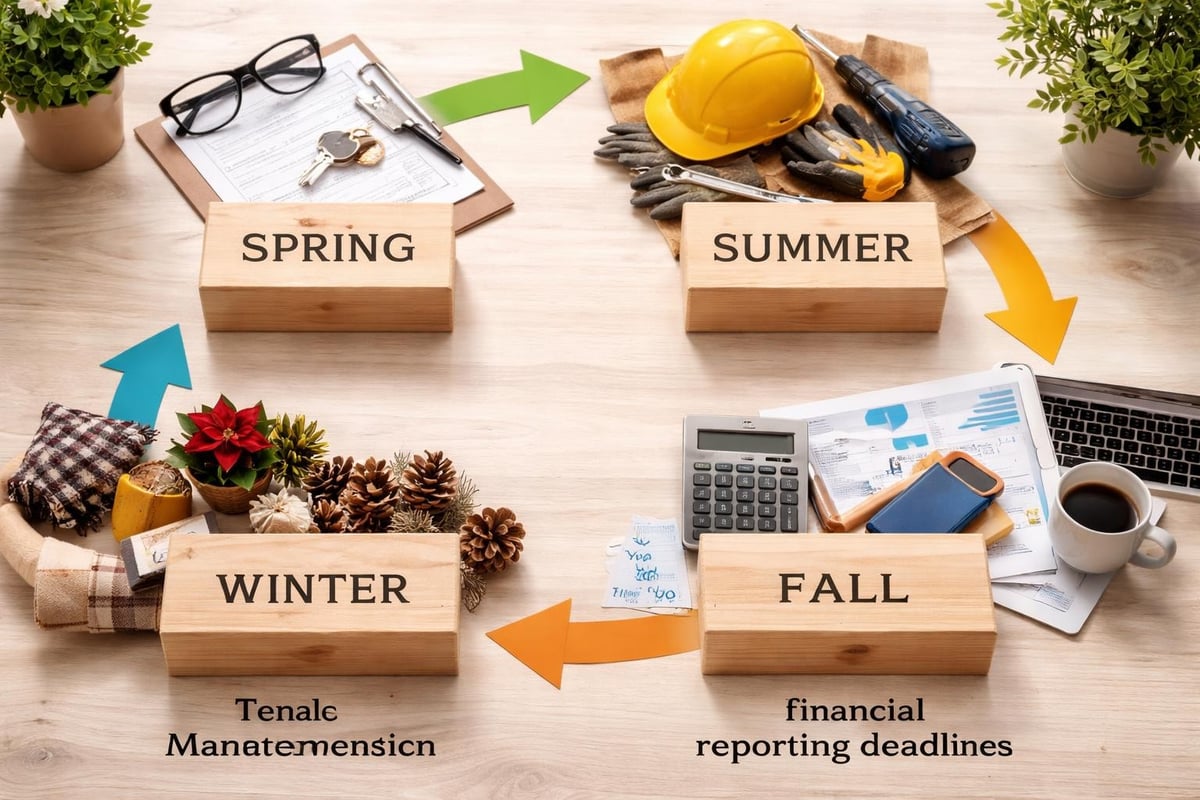
Time property management challenges vary significantly across the calendar year. The Greater New Orleans rental market experiences distinct seasonal patterns affecting manager workload and priority allocation.
Spring and early summer bring peak leasing season as families relocate before school years begin. Property managers must allocate extra time for marketing, property showings, and application processing during these months. Preparing vacant units in February and March prevents bottlenecks during April-June demand surges.
Winter months typically see reduced turnover but increased maintenance demands. Heating system failures, pipe freezing concerns, and storm damage from severe weather require different time allocations than summer air conditioning maintenance. Planning annual preventive maintenance during slower leasing periods optimizes resource utilization.
Developing Personal Productivity Habits
Individual work habits significantly impact time property management effectiveness beyond systems and technology. Top-performing property managers cultivate personal practices that maintain focus and energy throughout demanding workdays.
Morning routines establish productive momentum. Beginning each day with priority review and schedule confirmation prevents reactive firefighting mode. Tracking and prioritizing tasks systematically creates clarity about daily objectives before distractions begin.
Physical workspace organization reduces time wasted searching for documents, contact information, or property details. Digital organization proves equally important, with consistent file naming conventions and folder structures enabling rapid information retrieval. The property manager who locates lease documents in seconds versus five minutes gains hours weekly across numerous transactions.
High-Impact Personal Practices
- Starting workdays reviewing priorities before checking email
- Setting specific times for unavoidable interruptions like phone calls
- Taking brief breaks between focus blocks to maintain mental sharpness
- Ending days with next-day preparation and incomplete task review
- Protecting at least one hour daily for uninterrupted strategic work
Energy management complements time management. Property managers who schedule demanding analytical work during peak mental clarity hours while reserving routine tasks for lower-energy periods accomplish more without working longer hours.
Measuring and Improving Time Investment
Continuous improvement requires measuring how time investment translates into results. Property managers benefit from periodic time audits revealing where hours actually go versus where they should be allocated for maximum impact.
Tracking time by category for two weeks exposes patterns invisible during daily operations. Many managers discover they spend 30 percent of time on activities generating minimal value while chronically under-investing in high-impact areas like tenant retention and preventive maintenance.
Key performance indicators help evaluate whether time property management strategies produce desired outcomes:
- Average days to fill vacancies
- Maintenance request resolution time
- Percentage of rent collected within five days of due date
- Owner satisfaction ratings
- Emergency versus preventive maintenance ratio
When metrics deteriorate, time allocation analysis often reveals root causes. Rising vacancy days might indicate insufficient marketing time investment, while increasing emergency repairs suggest inadequate preventive maintenance scheduling.
Balancing Multiple Property Types
Experienced property managers often oversee diverse portfolios including single-family homes, multi-unit buildings, and commercial properties. Each property type demands different time investment patterns and management approaches.
Single-family homes typically require more individualized attention for each unit, with distinct owners, lease terms, and maintenance needs. Time property management for scattered properties includes travel between locations and coordination with multiple vendors lacking economies of scale.
Multi-unit properties concentrate responsibilities geographically but increase tenant interaction volume. Managers serving apartment complexes benefit from on-site presence but face higher communication demands from concentrated tenant populations. Understanding the critical role of time management in property operations becomes essential when managing diverse property types simultaneously.
Segmenting schedules by property type creates focus. Dedicating specific days to single-family property routes versus multi-unit property management reduces context-switching inefficiency. This geographic and categorical grouping enables managers to serve diverse portfolios effectively.
Building Sustainable Long-Term Systems
Short-term productivity hacks provide temporary relief but sustainable time property management requires building systems that function consistently across years. The difference between reactive scrambling and controlled efficiency lies in documented processes that survive personnel changes and portfolio growth.
Process documentation transforms individual knowledge into organizational assets. When tenant screening procedures exist only in a manager's head, vacation coverage becomes problematic and scaling impossible. Written procedures enable consistent execution regardless of who performs specific tasks.
Regular system review prevents outdated processes from persisting indefinitely. Annual evaluation of workflows, technology tools, and vendor relationships identifies improvement opportunities. Markets change, software evolves, and business models adapt-time management systems must similarly progress to maintain effectiveness.
For property management companies in competitive markets like New Orleans, operational efficiency directly impacts profitability and client satisfaction. Owners evaluating property management companies based on service quality increasingly recognize that effective time management translates into better property performance and more responsive service.
Training and Team Development
As property management operations grow, effective time property management extends beyond individual productivity to team coordination and development. Training team members in time management principles multiplies organizational capacity while preventing bottlenecks around key personnel.
New property managers benefit from structured onboarding that includes time management training alongside technical property management skills. Teaching priority frameworks, communication systems, and decision protocols from the beginning prevents inefficient habits from forming.
Experienced teams require ongoing development as portfolios expand and market conditions evolve. Regular training sessions addressing common time management challenges keep skills sharp and introduce new efficiency techniques. Sharing best practices among team members spreads innovation throughout the organization.
Clear role definition prevents duplicated effort and responsibility gaps. When team members understand exactly which tasks fall within their scope, coordination improves and time waste from unclear ownership decreases. This clarity becomes crucial for New Orleans property managers handling diverse portfolios across multiple neighborhoods.
Adapting to Market Changes
The rental property landscape continuously evolves with regulatory changes, economic shifts, and tenant expectation transformations. Time property management systems must adapt to remain effective as external conditions change.
Legislative updates affecting landlord-tenant law require time investment for compliance learning and procedure adjustment. Property managers who allocate dedicated time for regulatory education prevent costly violations while maintaining efficient operations within new frameworks.
Economic conditions influence time allocation priorities. During periods of high vacancy rates, managers must invest more heavily in marketing and tenant retention activities. Conversely, tight rental markets allow reduced marketing investment while demanding stronger systems for handling high application volumes efficiently.
Technology advancement creates both opportunities and demands. New software platforms promise efficiency gains but require implementation time and learning curves. Evaluating whether adoption costs justify long-term benefits requires strategic thinking about time investment versus productivity returns.
Mastering time property management separates property managers who merely survive from those who consistently deliver exceptional results for property owners and tenants alike. By implementing structured priority systems, leveraging technology effectively, and building sustainable workflows, property managers transform overwhelming responsibilities into manageable, profitable operations. Coxe Property Management and Leasing brings over 40 years of refined time management expertise to property owners throughout the Greater New Orleans area, combining proven systems with personalized service to maximize property performance while minimizing owner stress. Discover how our comprehensive approach to efficient property operations can transform your investment experience today.